
Taking a ‘Comfortable’ Seat.
For years I would dread the phrase, “now take a comfortable seat”. As I’m looking around for the couch, they would instruct students to sit cross-legged and find a tall spine. Some teachers would even mention a straight spine which I could never wrap my head around knowing the anatomy of the spine itself has 3 very distinct curves. I’d get into a cross-legged position and then with the body being so noisy with pain in my tight hips and hamstrings I would sit in tense pose until it was time to move. I could not possibly soften as relax as instructed no less actually draw awareness in over the noise of the physical form.

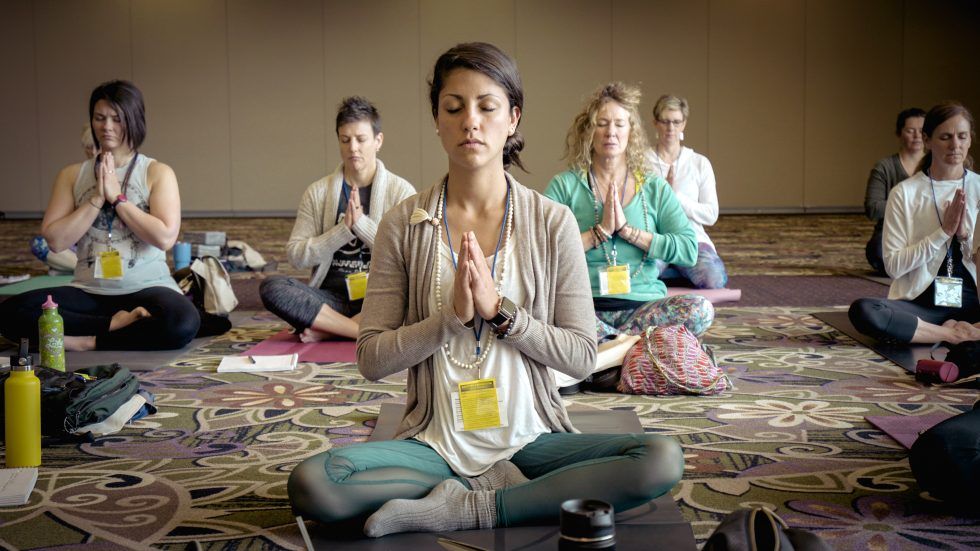
Over the years as my practice allowed me to sit more comfortably cross-legged I began to settle into meditation with more physical comfort. This allowed the body and mind to listen and absorb information being given from external and internal stimuli rather than the mind being so stuck in physical pain sensations. If sitting in physical pain, it is impossible for the body to soften, the muscles are unable to soften and the rigidity of the body blocks the flow of energy and peace. So how do we adjust our seat if this is not a comfortable, or even doable, shape for our body? First sit cross-legged and check in with the body. If the knees are high above the hip bones grab a prop to elevate the sit bones off the ground. This allows the knees to fall softly down, releasing any strain on the psoas muscle as well as allowing the muscles in the hips to soften. No more need to ‘hold’ the body in this shape- just allow the shape to hold the body softly. I like to use a folded blanket but you can use a towel, a yoga block, a cushion- anything to sit on the front edge and find the neutral pelvis. If this is a no go all around or there is acute pain in the hips or knees then simply move to a chair. Yes- you can find a tall spine seated in a chair and get ALL of the benefits of meditation there. As the body opens and flexes with asana practice your seat will shift. Start where you are.
Begin to tilt the pelvis forward and back until you find your neutral. From that grounding, heavy base we find the oppositional pull up the spine to ground the spine as well as stabilize from above. Imagine the breath moving up the spine from the seat and stacking each vertebrae gently on the one below all the way up the spine. Once you reach the top of the spine drop the chin slightly and pull the head back over the top of the spine. It should be balanced and weightless, fully supported by the spine. Watch the breath move through the top of the mouth, up to the third eye just above and behind the brow, and finally lifting through the crown of the head. Settle the awareness around the breath and just be. Hands soft on the thighs or taking the mudra of your choice.
Recent Posts